Class 9 Maths Ganita Manjari
Chapter 1 – Orienting Yourself – The Use of Coordinates
Hello students! I have shared all the solutions for Chapter 1 – Orienting Yourself: The Use of Coordinates below. Click on any section to jump directly to it:
Just as ancient city planners in the Sindhu-Sarasvatī civilisation used North-South and East-West grids to locate shops, modern mathematics uses the 2-D Cartesian Coordinate System to define any point on a plane.
Core Concepts
- The Framework: We define a horizontal line as the x-axis, a vertical line as the y-axis, and their intersection as the Origin O\((0, 0)\).
- The Rule: Point P\((x, y)\) means \(x\) is the distance from the y-axis and \(y\) is the distance from the x-axis.
Exercise Set 1.1
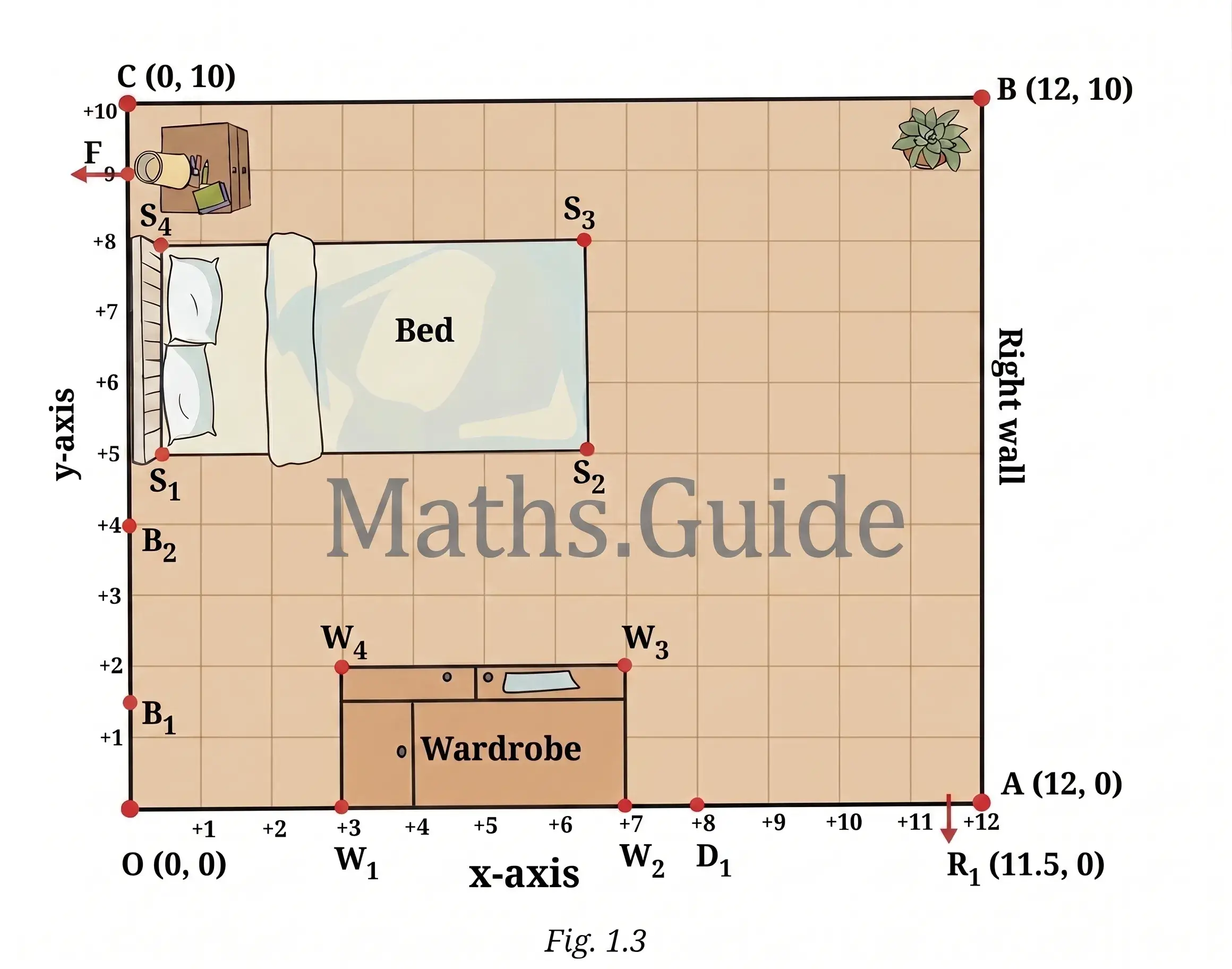
1) Fig. 1.3 shows Reiaan’s room with points OABC marking its corners. The x- and y-axes are marked in the figure. Point O is the origin.
Referring to Fig. 1.3, answer the following questions:
(i) If D₁R₁ represents the door to Reiaan’s room, how far is the door from the left wall (the y-axis) of the room? How far is the door from the x-axis?
Solution
The door D₁R₁ is located on the x-axis.
Therefore, its distance of the door from the left wall (y-axis) is 8 units.
The distance of the door from x-axis is 0 units.
Answer Distance from \( \color{red}{ y-axis = 8 \text{ units},} \) Distance from \( \color{red}x-axis = 0 \text{ units} \)
(ii) What are the coordinates of D₁?
Solution
Since D₁ lies on the x-axis, its x-coordinate is 8 and y-coordinate is 0.
Thus, the coordinates are given by\( \ \Rightarrow \color{green}{(x, y) = (8, 0)} \)
Answer D₁ = (8, 0)
(iii) If R₁ is the point (11.5, 0), how wide is the door? Do you think this is a comfortable width for the room door? If a person in a wheelchair wants to enter the room, will he/she be able to do so easily?
Solution
Width of the door is the distance between D₁(8, 0) and R₁(11.5, 0) , which lie on the x-axis. \[ \color{green}{\text{Width} = 11.5 - 8 \Rightarrow 3.5\text{ units}} \] Yes, this is a comfortable width for a room door. If a person in a wheelchair wants to enter the room, he/she be able to do so easily.
Answer Width = 3.5 units. Yes, it is accessible.
(iv) If B₁(0, 1.5) and B₂(0, 4) represent the ends of the bathroom door, is the bathroom door narrower or wider than the room door?
Solution
Width of the bathroom door is the distance between B₁(0, 1.5) and B₂(0, 4), which lie on the y-axis. \[ \color{green}{\text{Width of bathroom door} = 4 - 1.5 \Rightarrow 2.5 \text{ units}} \] \[ \color{green}{\text{Width of room door} = 3.5 \text{ units}} \] Therefore, the bathroom door is narrower than the room door.
AnswerThe bathroom door is narrower.
Think and Reflect (Page 5)
1. What are the standard widths for a room door? Look around your home and in school.
Answer Standard widths of the room doors are usually 2.5 ft to 3 ft
2. Are the doors in your school suitable for people in wheelchairs?
AnswerYes, they are suitable.
Quadrant Logic
| Quadrant | x-coordinate | y-coordinate | Signs |
|---|---|---|---|
| Quadrant I | Positive | Positive | \((+, +)\) |
| Quadrant II | Negative | Positive | \((-, +)\) |
| Quadrant III | Negative | Negative | \((-, -)\) |
| Quadrant IV | Positive | Negative | \((+, -)\) |
Think and Reflect (Page 7)
1. What is the x-coordinate of a point on the y-axis?
Answer For any point on the y-axis, the horizontal distance from the y-axis is zero. Therefore, its 𝑥-coordinate is 0
2. Is there a similar generalisation for a point on the 𝑥-axis?
Solution Yes, for any point on the 𝑥-axis, its vertical distance from the 𝑥-axis is zero. Therefore, its y-coordinate is always 0.
Answer Yes, the y-coordinate is 0
3. Does point Q(𝑦, 𝑥) ever coincide with point P(𝑥, 𝑦)? Justify your answer.
Solution The points Q(𝑦, 𝑥) and P(𝑥, 𝑦) will coincide if and only if their corresponding coordinates are equal, which means 𝑥 = 𝑦. In all other cases where 𝑥 ≠ 𝑦, they represent different points in the plane.
AnswerYes, they coincide only when 𝑥 = 𝑦
4. If 𝑥 ≠ 𝑦, then (𝑥, 𝑦) ≠ (𝑦, 𝑥); and (𝑥, 𝑦) = (𝑦, 𝑥) if and only if 𝑥 = 𝑦. Is this claim true?
Answer Yes, the claim is true. Ordered pairs uniquely represent points in the Cartesian plane. Changing the order of coordinates maps to a different location unless the two values are identical.
Exercise Set 1.2
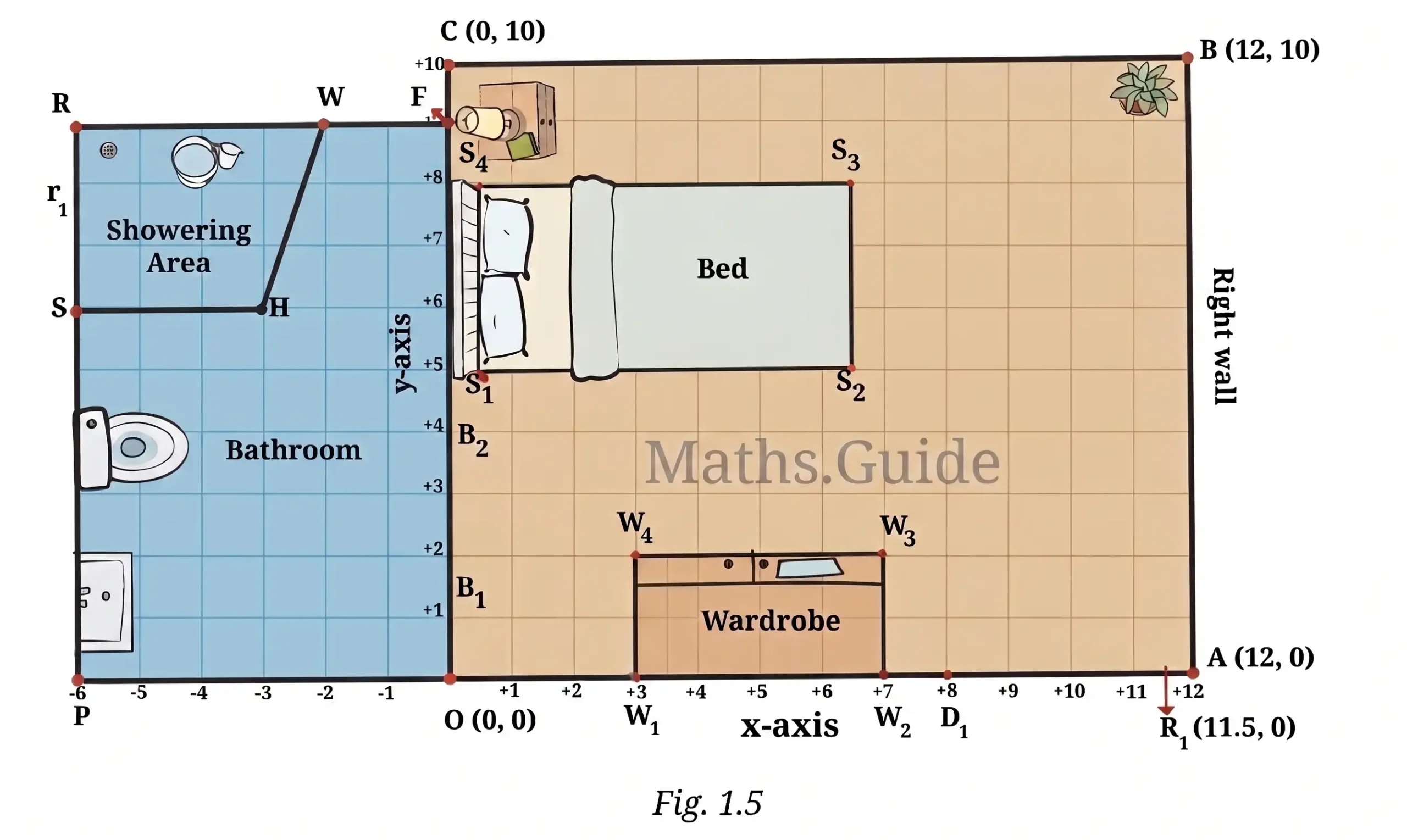
On a graph sheet, mark the x-axis and y-axis and the origin O. Mark points from (-7, 0) to (13, 0) on the x-axis and from (0, -15) to (0, 12) on the y-axis. (Use the scale 1 cm = 1 unit.) Using Fig. 1.5, answer the given questions.
1. Place Reiaan’s rectangular study table with three of its feet at the points( 8, 9), (11, 9) and (11, 7).
(i) Where will the fourth foot of the table be?
Solution
Since the table is rectangular, its opposite sides must be parallel and equal. The fourth foot must be vertically below (8, 9) and horizontally aligned with (11, 7). Therefore, its 𝑥-coordinate is 8 and its 𝑦-coordinate is 7.
Answer The fourth foot of the table = (8, 7)
(ii) Is this a good spot for the table?
Answer Yes its a good spot.
(iii) What is the width of the table? The length? Can you make out the height of the table?
Solution
The length is the horizontal distance: 11 - 8 = 3 units.
The width is the vertical distance: 9 - 7 = 2 units.
Because this is a 2-D Cartesian plane representing the floor plan, it only shows the x and y dimensions. The height cannot be determined from this 2-D map.
Answer Length = 3 units, Width = 2 units, Height cannot be determined.
2. If the bathroom door has a hinge at B₁ and opens into the bedroom, will it hit the wardrobe? Are there any changes you would suggest if the door is made wider?
Answer
The bathroom door B₁B₂ has a width of 2.5 units on y-axis. When it opens, the door edge will reach the point \((2.5,1.5)\). The wardrobe starts at 𝑥 = 3 units. So, it will not hit the wardrobe.
If the door is made wider, it will hit the wardrobe. In that case, the wardrobe should be moved slightly to the right or the bathroom room should open inward into the bathroom.
3. Look at Reiaan’s bathroom.
(i) What are the coordinates of the four corners O, F, R, and P of the bathroom?
Answer Coordinates of the four corners of the bathroom are: \[ \begin{aligned} \color{magenta} \textbf{O} & \color{green} (0,0) \\ \color{magenta} \textbf{F} & \color{green} (0,9) \\ \color{magenta} \textbf{R} & \color{green} (-6,9) \\ \color{magenta} \textbf{P} & \color{green} (-6,0) \end{aligned} \]
(ii) What is the shape of the showering area SHWR in Reiaan’s bathroom? Write the coordinates of the four corners.
Answer Shape: Trapezium, Coordinates of the four corners of the bathroom are: \[ \begin{aligned} \color{magenta} \textbf{S} & \color{green} (-6,6) \\ \color{magenta} \textbf{H} & \color{green} (-3,6) \\ \color{magenta} \textbf{W} & \color{green} (-2,9) \\ \color{magenta} \textbf{R} & \color{green} (-6,9) \end{aligned} \]
(iii) Mark off a 3 ft × 2 ft space for the washbasin and a 2 ft × 3 ft space for the toilet. Write the coordinates of the corners of these spaces.
Answer Coordinates of Washbasin (3 ft × 2 ft) are \( \begin{aligned} = \color{magenta}(-6, 0), (-3, 0), (-3, 2), (-6, 2) \end{aligned} \)
Coordinates of toilet (2 ft × 3 ft) are \( \begin{aligned} = \color{magenta}(-6, 2), (-4, 2), (-4, 5), (-6, 5) \end{aligned} \)4. Other rooms in the house:
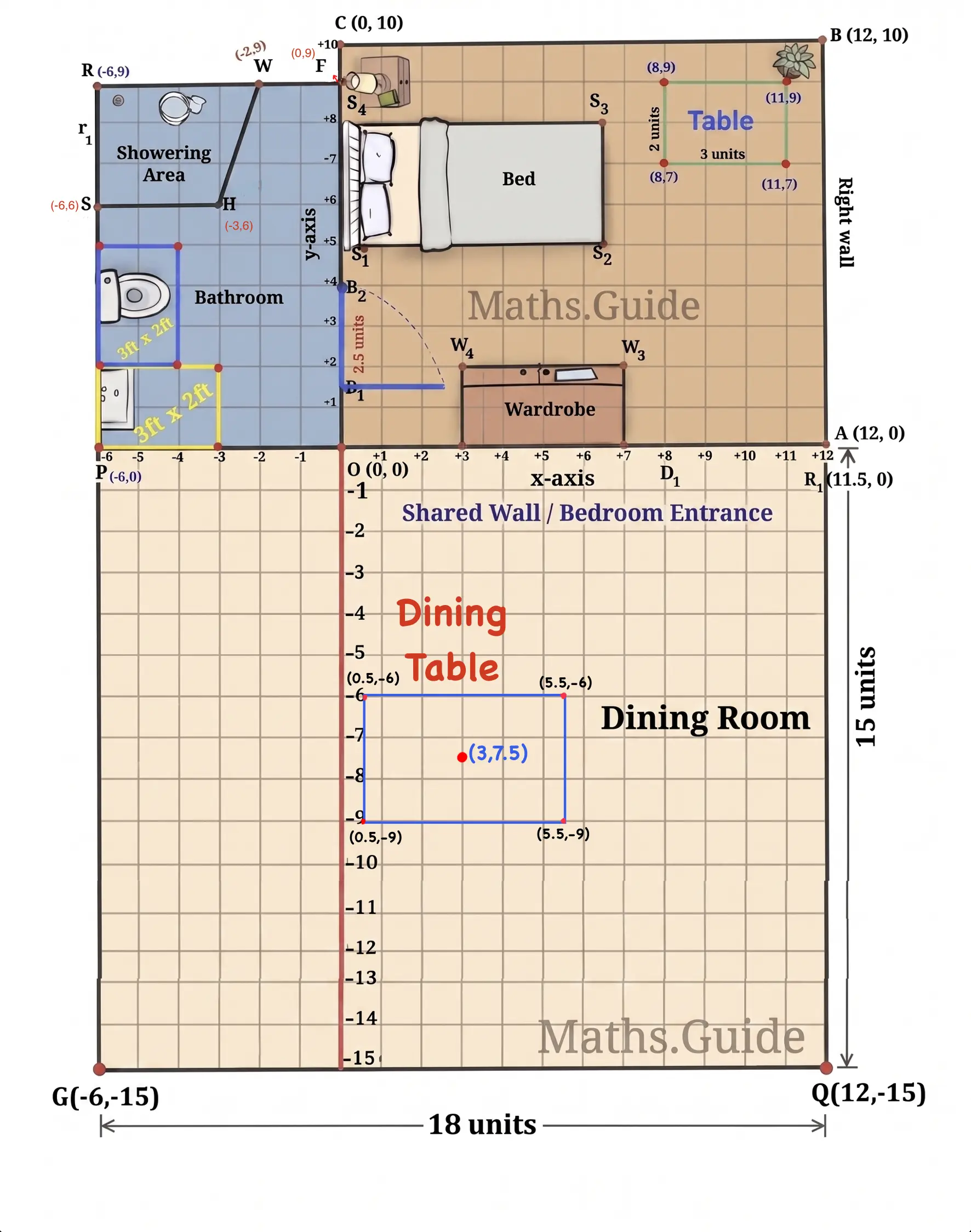
(i) Reiaan’s room door leads from the dining room which has the length 18 ft and width 15 ft. The length of the dining room extends from point P to point A. Sketch the dining room and mark the coordinates of its corners.
Solution
The dining room extends along the 𝑥-axis from point P to point A.
P = \( \color{green}{(-6, 0)} \) and
A = \( \color{green}{(12, 0)} \)
Length of PA = \( \color{green}{12 - (-6) = 18 \text{ ft}} \)
This matches the \(18 \text{ ft}\) length given in the question!
The dining room is 15 ft wide which extend down by 15 units on the negative y axis.
PAQG is the required Dining room.
- P = \( \color{green}{(-6, 0)} \)
- A = \( \color{green}{(12, 0)} \)
- Q = \( \color{green}{(12, -15)} \)
- G = \( \color{green}{(-6, -15)} \)
Answer The coordinates of the dining room corners are → (-6, 0), (12, 0), (12, -15), (-6, -15)
(ii) Place a rectangular 5 ft × 3 ft dining table precisely in the centre of the dining room. Write down the coordinates of the feet of the table.
Solution
Step 1: Find the exact center of the dining room.
Length PA (𝑥-axis) : P = (-6, 0) and A = (12, 0)
𝑥₁ = -6, 𝑥₂ = 12
Centre of 𝑥-coordinate = \( \color{green}{\dfrac{-6 + 12}{2} \implies 3} \)
Width AQ (𝑦-axis) : A = (12, 0) and Q=(12,-15)
𝑦₁ = 0, 𝑦₂ = -15
centre of 𝑦-coordinate = \( \color{green}{\dfrac{0 + (-15)}{2} \implies -7.5} \)
So, the center of the dining room is at (3, -7.5).
Step 2: Table dimensions: 5 ft × 3 ft
The table is \(5 \text{ ft}\) long and \(3 \text{ ft}\) wide.Half of its length and width will be:
Half-length (along x-axis) = \( \color{green}{5 \div 2 = 2.5} \) units
Half-width (along y-axis) = \( \color{green}{3 \div 2 = 1.5} \) units
Step 3: Calculate the coordinates for each of the four feet of the table.
Starting from our dining room center point \( \color{green}{(3, -7.5)} \), we will add and subtract these half-lengths and half-widths of the table:
- Bottom-Left foot: Move left 2.5 and down 1.5
\( \color{green}{(3 - 2.5, -7.5 - 1.5) = (0.5, -9)} \) - Bottom-Right foot: Move right 2.5 and down 1.5
\( \color{green}{(3 + 2.5, -7.5 - 1.5) = (5.5, -9)} \) - Top-Right foot: Move right 2.5 and up 1.5
\( \color{green}{(3 + 2.5, -7.5 + 1.5) = (5.5, -6)} \) - Top-Left foot: Move left 2.5 and up 1.5
\( \color{green}{(3 - 2.5, -7.5 + 1.5) = (0.5, -6)} \)
Answer The coordinates of the four feet of the dining table are: (0.5, -9), (5.5, -9), (5.5, -6), (0.5, -6)
1.4 Distance Between Two Points in the 2-D Plane
We know how to find the distance between two points if they are on the axes or if they form a line segment parallel to the axes. What should we do if the segment joining the points is not parallel to either axis? We can use the Baudhāyana–Pythagoras theorem to find the distance between any two points in the 𝑥𝑦-plane.
In general, the distance between the points (𝑥₁,𝑦₁) and (𝑥₂,𝑦₂) is given by: \[ \color{magenta}{\text{Distance}} = \sqrt{(x_2 - x_1)^2 + (y_2 - y_1)^2} \]
Think and Reflect (Page 9)
1. In moving from A (3, 4) to D (7, 1), what distance has been covered along the 𝑥-axis? What about the distance along the 𝑦-axis?
Solution
The distance moved along the x-axis is given by the difference in x-coordinates:
\( \color{green}{\text{Distance along x-axis} = 7 - 3 = 4 \text{ units}} \)
The distance moved along the y-axis is given by the difference in y-coordinates:
\( \color{green}{\text{Distance along y-axis} = 4 - 1 = 3 \text{ units}} \)
Answer 4 units along x-axis, 3 units along 𝑦-axis
2. Can these distances help you find the distance AD?
Solution
Yes. These distances form the base and height of a right-angled triangle. Using the Baudhāyana–Pythagoras Theorem:
\[
\begin{align*}
AD &= \sqrt{4^2 + 3^2} \\
&= \sqrt{16 + 9} \\
&= \sqrt{25} \\
&= 5 \text{ units}
\end{align*}
\]
Answer Yes, the distance AD is 5 units.
Think and Reflect (Page 11)
1. What has remained the same and what has changed with this reflection (in the 𝑦-axis)?
Answer
What remains the same:
- Lengths of the sides and angles remain unchanged.
- Shape and Size remains original.
- 𝑦-coordinates do not change.
What changed:
- The signs of the 𝑥-coordinates are reversed.
2. Would these observations be the same if ΔADM is reflected in the 𝑥-axis (instead of the 𝑦-axis)?
Answer If reflected in the 𝑥-axis, The side lengths and 𝑥-coordinates would remain the same, but the 𝑦-coordinates would change their sign.
In both cases, the distance between any two points remains exactly the same.
End-of-Chapter Exercises
1. What are the 𝑥-coordinate and 𝑦-coordinate of the point of intersection of the two axes?
Solution
The intersection of the 𝑥-axis and the 𝑦-axis is called the origin.
𝑥-coordinate = 0 and 𝑦-coordinate = 0
Answer Origin= O(0, 0)
2. Point W has 𝑥-coordinate equal to – 5. Can you predict the coordinates of point H which is on the line through W parallel to the 𝑦-axis? Which quadrants can H lie in?
Solution
A line parallel to the 𝑦-axis that passes through a point with an 𝑥-coordinate of –5 will have all its points sharing the same 𝑥-coordinate. So, the coordinate of H is (-5,y).
- If \( y > 0 \), H is in Quadrant II.
- If \( y < 0 \), H is in Quadrant III.
- If \( y = 0 \), H is on the x-axis.
Answer H = (–5, y). It can lie in Quadrant II or Quadrant III.
3. Consider the points R (3, 0), A (0, – 2), M (– 5, – 2) and P (– 5, 2). If they are joined in the same order, predict:
(i) Two sides of RAMP that are perpendicular to each other.
Answer AM and MP are perpendicular to each other
(ii) One side of RAMP that is parallel to one of the axes.
Answer AM is parallel to the x-axis, and MP is parallel to the y-axis..
(iii) Two points that are mirror images of each other in one axis. Which axis will this be?
The points M(–5, –2) and P(–5, 2) have the same x-coordinate but opposite y-coordinates. Thus, they are mirror images across the x-axis.
Answer M and P are mirror images in the x-axis.
4. Plot point Z (5, – 6) on the Cartesian plane. Construct a right-angled triangle IZN and find the lengths of the three sides.
Solution
Let I = (5, 0) and N = (0, –6). The points I, Z, N form a right-angled triangle at Z(5, –6).
Length IZ = \( | –6 - 0 | \implies 6 \) units.
Length ZN = \( | 5 - 0 | \implies 5 \) units.
\(
\begin{aligned}
\color{magenta}{\text{Distance}} &= \color{magenta} \sqrt{(x_2 - x_1)^2 + (y_2 - y_1)^2} \\
& I = (5, 0) , N = (0, –6) \\
\text{Length IN} &= \sqrt{(0 - 5)^2 + (-6 - 0)^2} \\
&= \sqrt{(- 5)^2 + (-6)^2} \\
&= \sqrt{25 + 36} \\
&= \sqrt{61} \ units \end{aligned}
\)
Answer Length of the three sides are 5, 6, and \( \sqrt{61} \) units.
5. What would a system of coordinates be like if we did not have negative numbers? Would this system allow us to locate all the points on a 2-D plane?
Solution
If we did not have negative numbers, we would only have positive x and y axes. This will only show positive coordinates in the I quadrant of the Cartesian plane.
Such a system would NOT allow us to locate all points on a 2-D plane.
Answer It would only cover Quadrant I. No, it wouldn't locate all points.
6. Are the points M (– 3, – 4), A (0, 0) and G (6, 8) on the same straight line? Suggest a method to check this without plotting and joining the points.
Solution
We can check if three points are collinear by finding distances between them. If the sum of the two smaller distances equals the largest distance, they lie on a straight line.
\( \begin{aligned} \\ \color{magenta}{\text{Distance}} &= \color{magenta} \sqrt{(x_2 - x_1)^2 + (y_2 - y_1)^2} \\[4pt] & M (- 3, - 4), A (0, 0) , G (6, 8) \\[4pt] MA &= \sqrt{(0 - (-3))^2 + (0 - (-4))^2} \\ &= \sqrt{3^2 + 4^2} \\ &= \sqrt{25} \\ \color{green}MA &= \color{green}5 \ units \\ \\ AG &= \sqrt{(6 - 0)^2 + (8 - 0)^2} \\ & = \sqrt{6^2 + 8^2} \\ &= \sqrt{100} \\ \color{green} AG & = \color{green} 10 \ units \\ \\ MG &= \sqrt{(6 - (-3))^2 + (8 - (-4))^2} \\ &= \sqrt{(6+3)^2 + (8 + 4)^2} \\ &= \sqrt{9^2 + 12^2} \\ &= \sqrt{81 + 144} \\ &= \sqrt{225} \\ \color{green} MG &= \color{green} 15 \ units \\ \\ 5 + 10 &= 15 \\ \therefore MA + AG &= MG \end{aligned} \)The points M,A and G lie on the same straight line.
Answer Yes, the points lie on a same straight line because MA + AG = MG.
7. Use your method (from Problem 6) to check if the points R (– 5, – 1), B (– 2, – 5) and C (4, – 12) are on the same straight line. Now plot both sets of points and check your answers.
Solution
We can check if three points are collinear by finding distances between them. If the sum of the two smaller distances equals the largest distance, they lie on a straight line.
\( \begin{aligned} \\ \color{magenta}{\text{Distance}} &= \color{magenta} \sqrt{(x_2 - x_1)^2 + (y_2 - y_1)^2} \\[4pt] & R (– 5, – 1), B (– 2, – 5) , C (4, – 12) \\[4pt] RB& = \sqrt{(-2 - (-5))^2 + (-5 - (-1))^2} \\ & = \sqrt{(-2 + 5)^2 + (-5 + 1)^2} \\ &= \sqrt{3^2 + (-4)^2} \\ &= \sqrt{25} \\ \color{green} RB &= \color{green} 5 \ units \\ \\ BC &= \sqrt{(4 - (-2))^2 + (-12 - (-5))^2} \\ &= \sqrt{(4 + 2)^2 + (-12 + 5)^2} \\ &= \sqrt{6^2 + (-7)^2} \\ &= \sqrt{36 + 49} \\ \color{green} BC &= \color{green} \sqrt{85} \ units \\ \\ RC & = \sqrt{(4 - (-5))^2 + (-12 - (-1))^2} \\ & = \sqrt{(4 + 5)^2 + (-12 + 1)^2} \\ &= \sqrt{9^2 + (-11)^2} \\ &= \sqrt{81 + 121} \\ \color{green} RC &= \color{green} \sqrt{202} \ units \\ \\ 5 + \sqrt{85} & \neq \sqrt{202} \\ \therefore RB + BC & \neq RC \end{aligned} \)The points R,B and C do not lie on the straight line.
Answer No, they are not on the same straight line.
8. Using the origin as one vertex, plot the vertices of:
(i) A right-angled isosceles triangle.
(ii) An isosceles triangle with one vertex in Quadrant III and the other in Quadrant IV.
(i) O(0, 0), A(4, 0) and B(0, 4).
\(
\begin{aligned}
\\
\angle BOA &= 90^\circ \\
OA = OB &= 4 \ units \\
\end{aligned}
\)
Answer BOA is right-angled isosceles triangle
(ii) An isosceles triangle with the origin O(0, 0) as one vertex, and the other two vertices placed in Quadrant III C (-3, -4) and IV D(3, -4).Answer OCD is an isosceles triangle with the origin O(0, 0) as one vertex, and the other two vertices placed in Quadrant III C (-3, -4) and IV D(3, -4)
9. The following table shows the coordinates of points S, M and T. In each case, state whether M is the midpoint of segment ST. Justify your answer. When M is the mid-point of ST, can you find any connection between the coordinates of M, S and T?
Solution The midpoint M of points S(𝑥₁, y₁) and T(𝑥₂, y₂) is calculated as: \( \color{magenta} M = \left( \dfrac{x_1 + x_2}{2}, \dfrac{y_1 + y_2}{2} \right) \).
| S | M | T | Is M midpoint? | Reason |
|---|---|---|---|---|
| (–3, 0) | (0, 0) | (3, 0) | Yes | \( \left(\dfrac{-3+3}{2}, \dfrac{0+0}{2}\right) = (0, 0) \) |
| (2, 3) | (3, 4) | (4, 5) | Yes | \( \left(\dfrac{2+4}{2}, \dfrac{3+5}{2} \right) = (3, 4) \) |
| (0, 0) | (0, 5) | (0, –10) | No | \( \left(\dfrac{0+0}{2}, \dfrac{0-10}{2}\right) = (0, -5) \) |
| (–8, 7) | (0, –2) | (6, –3) | No | \( \left(\dfrac{-8+6}{2}, \dfrac{7-3}{2} \right) = (-1, 2) \) |
Connection: The coordinates of M are the average of the coordinates of S and T.
10. Use the connection you found to find the coordinates of B given that M (–7, 1) is the midpoint of A (3, – 4) and B (x, y).
Solution Midpoint of AB = M
\[
\begin{aligned}
\\
A(3, - 4) \ , \ B (x, y) \ & , \ M(-7, 1) \\ \\
\color{magenta} \left( \dfrac{x_1 + x_2}{2}, \dfrac{y_1 + y_2}{2} \right) &= \color{magenta} M \\[4pt]
\left( \dfrac{3 + x}{2}, \dfrac{-4 + y}{2} \right) &= (-7,1) \\[4pt]
\end{aligned}
\]
\[
\begin{array}{c|c}
\begin{aligned}
x - co&ordinate \\ \\
\dfrac{3 + x}{2} & = -7 \\[4pt]
3 + x &= -14 \\
x &= -14 -3 \\
\color{red} x &= \color{red} -17 \\
\end{aligned}
&
\begin{aligned}
y - co&ordinate \\ \\
\dfrac{-4 + y}{2} &= 1\\[4pt]
-4 + y &= 2\\
y &= 2 + 4\\
\color{red} y & = \color{red} 6 \\
\end{aligned}
\end{array}
\]
Answer The coordinates of B are (–17, 6).
11. Let P, Q be points of trisection of AB, with P closer to A, and Q closer to B. Using your knowledge of how to find the coordinates of the midpoint of a segment, how would you find the coordinates of P and Q? Do this for the case when the points are A (4, 7) and B (16, –2).
Solution
Given the points A(4, 7) and B(16, -2). Let the points of trisection be P(a, b) and Q(c, d), where P is closer to A and Q is closer to B.
P and Q are points of trisection of AB:
1. P is the midpoint of AQ.
2. Q is the midpoint of PB .
Midpoint \( = \color{magenta} \left( \dfrac{x_1 + x_2}{2}, \dfrac{y_1 + y_2}{2} \right) \)
Step 1: Find the 𝑥-coordinates (a and c)
P is mid-point of AQ \( \implies a = \dfrac{c + 4}{2} \color{magenta} \longrightarrow \enclose{circle}{1} \)
Q is mid-point of PB \( \implies c = \dfrac{a + 16}{2}\color{magenta} \longrightarrow \enclose{circle}{2} \)
\[
\begin{aligned}
&\text{Substitute } a \text{ in } \enclose{circle}{1} \\ \\
c &= \dfrac{\left( \dfrac{c + 4}{2} \right) + 16}{2} \\[6pt]
c &= \dfrac{\left( \dfrac{c + 4 + 32}{2} \right) }{2} \\[6pt]
c &= \dfrac{c + 4 + 32}{4} \\[6pt]
4c &= c + 36 \\
3c &= 36 \\
\color{green} c &= \color{green}12 \\[6pt]
&\text{Substitute } C \text{ in } \enclose{circle}{1} \\ \\
a &= \dfrac{12 + 4}{2} \\[6pt]
&= \dfrac{16}{2} \\[6pt]
\color{green} a & = \color{green} 8
\end{aligned}
\]
Step 2: Find the 𝑦-coordinates (b and d)
P is mid-point of AQ \( \implies b = \dfrac{d + 7}{2} \color{magenta} \longrightarrow \enclose{circle}{3} \)
Q is mid-point of PB \( \implies d = \dfrac{b - 2}{2}\color{magenta} \longrightarrow \enclose{circle}{4} \)
\[
\begin{aligned}
&\text{Substitute } b \text{ in } \enclose{circle}{4} \\ \\
d &= \dfrac{\left( \dfrac{d + 7}{2} \right) - 2}{2} \\[6pt]
d &= \dfrac{\left( \dfrac{d + 7 - 4}{2} \right) }{2} \\[6pt]
d &= \dfrac{d + 7 - 4}{4} \\[6pt]
4d &= d + 3 \\
3d &= 3 \\
\color{green} d &= \color{green}1 \\[6pt]
&\text{Substitute } d \text{ in } \enclose{circle}{3} \\ \\
b &= \dfrac{1 + 7}{2} \\[6pt]
&= \dfrac{8}{2} \\[6pt]
\color{green} b & = \color{green} 4
\end{aligned}
\]
Answer The coordinates are P(8, 4) and Q(12, 1).
12. (i) Given the points A (1, – 8), B (– 4, 7) and C (–7, – 4), show that they lie on a circle K whose center is the origin O (0, 0). What is the radius of circle K?
(ii) Given the points D (– 5, 6) and E (0, 9), check whether D and E lie within the circle, on the circle, or outside the circle K.
Solution
(i) Show points lie on circle K and find radius
Distance from origin formula: \( \color{magenta} d = \sqrt{x^2 + y^2} \)
\[
\begin{aligned}
OA &= \sqrt{1^2 + (-8)^2} \\
&= \sqrt{1 + 64} \\
&= \sqrt{65} \text{ units} \\[6pt]
OB &= \sqrt{(-4)^2 + 7^2} \\
&= \sqrt{16 + 49} \\
&= \sqrt{65} \text{ units} \\[6pt]
OC &= \sqrt{(-7)^2 + (-4)^2} \\
&= \sqrt{49 + 16} \\
&= \sqrt{65} \text{ units} \\[6pt]
\color{red} OA = OB = OC & \color{red} \implies \sqrt{65} \text{ units}
\end{aligned}
\]
All three points lie on the circle K.
Radius of circle \( \color{red} K = \sqrt{65} \ units \).
(ii) Check positions of D and E
We know \( r = \sqrt{65} \ units \).
- If distance < radius, the point is inside (within) the circle.
- If distance = radius, the point is on the circle.
- If distance > radius, the point is outside the circle.
\[ \begin{aligned} OE &= \sqrt{0^2 + 9^2} \\ &= \sqrt{0 + 81} \\ &= \sqrt{81} \text{ units} \end{aligned} \] Since \( \sqrt{81} > \sqrt{65} \) , point E lies outside the circle.
Answer
(i) All points lie on circle K. The radius \( = \sqrt{65} \) units.
(ii) Point D lies within the circle, and point E lies outside the circle.
13. The midpoints of the sides of triangle ABC are the points D, E, and F. Given that the coordinates of D, E, and F are (5, 1), (6, 5), and (0, 3), respectively, find the coordinates of A, B and C.
Solution
\[ \begin{aligned} D &\text{ is mid-point of } AB \\ \dfrac{x_1 + x_2}{2} = 5 & \implies x_1 + x_2 = 10 \color{magenta} \longrightarrow \enclose{circle}{1} \\[6pt] \dfrac{y_1 + y_2}{2} = 1 & \implies y_1 + y_2 = 2 \color{blue} \longrightarrow \enclose{circle}{2} \\[12pt] E & \text{ is mid-point of } BC \\ \dfrac{x_2 + x_3}{2} = 6 & \implies x_2 + x_3 = 12 \color{magenta} \longrightarrow \enclose{circle}{3} \\[6pt] \dfrac{y_2 + y_3}{2} = 5 & \implies y_2 + y_3 = 10 \color{blue} \longrightarrow \enclose{circle}{4} \\[12pt] F &\text{ is mid-point of } AC \\ \dfrac{x_1 + x_3}{2} = 0 & \implies x_1 + x_3 = 0 \color{magenta} \longrightarrow \enclose{circle}{5} \\[6pt] \dfrac{y_1 + y_3}{2} = 3 &\implies y_1 + y_3 = 6 \color{blue} \longrightarrow \enclose{circle}{6} \\ \\ \text{Add } \color{magenta} \enclose{circle}{1}, \enclose{circle}{3}, \enclose{circle}{5} \\[6pt] x_1 + x_2 + x_2 + x_3 + x_1 + x_3 &= 10 + 12 + 0 \\ 2x_1 + 2x_2 + 2x_3 &= 22 \\ 2(x_1 + x_2 + x_3) &= 22 \\ x_1 + x_2 + x_3 &= 11 \color{magenta} \longrightarrow \enclose{circle}{7} \\[12pt] \text{Substitute } & \enclose{circle}{1} \text{ in } \enclose{circle}{7} \\ 10 + x_3 &= 11 \\ x_3 &= 11 - 10 \\ \color{green} x_3 &\color{green}= 1 \\[12pt] \text{Substitute } & \enclose{circle}{3} \text{ in } \enclose{circle}{7} \\ x_1 + 12 &= 11 \\ x_1 &= 11 - 12 \\ \color{green} x_1 &\color{green}= -1 \\[12pt] \text{Substitute } & \enclose{circle}{5} \text{ in } \enclose{circle}{7} \\ x_2 + 0 &= 11 \\ \color{green} x_2 &\color{green}= 11 \\ \\ \text{Add } \color{blue} \enclose{circle}{2}, \enclose{circle}{4}, \enclose{circle}{6} \\[6pt] y_1 + y_2 + y_2 + y_3 + y_1 + y_3 &= 2 + 10 + 6 \\ 2y_1 + 2y_2 + 2y_3 &= 18 \\ 2(y_1 + y_2 + y_3) &= 18 \\ y_1 + y_2 + y_3 &= 9 \color{magenta} \longrightarrow \enclose{circle}{8} \\[12pt] \text{Substitute } & \enclose{circle}{2} \text{ in } \enclose{circle}{8} \\ 2 + y_3 &= 9 \\ y_3 &= 9 - 2 \\ \color{green} y_3 &\color{green}= 7 \\[12pt] \text{Substitute } & \enclose{circle}{4} \text{ in } \enclose{circle}{8} \\ y_1 + 10 &= 9 \\ y_1 &= 9 - 10 \\ \color{green} y_1 &\color{green}= -1 \\[12pt] \text{Substitute } & \enclose{circle}{6} \text{ in } \enclose{circle}{8} \\ y_2 + 6 &= 9 \\ y_2 &= 9 - 6 \\ \color{green} y_2 &\color{green}= 3 \end{aligned} \]
Answer A(–1, –1), B(11, 3), and C(1, 7).
14. A city has two main roads which cross each other at the centre of the city. These two roads are along the North–South (N–S) direction and East–West (E–W) direction. All the other streets of the city run parallel to these roads and are 200 m apart. There are 10 streets in each direction.
(i) Using 1 cm = 200 m, draw a model of the city in your notebook. Represent the roads/streets by single lines.
(ii)There are street intersections in the model. Each street intersection is formed by two streets — one running in the N–S direction and another in the E–W direction. Each street intersection is referred to in the following manner: If the second street running in the N–S direction and 5th street in the E–W direction meet at some crossing, then we call this street intersection (2, 5). Using this convention, find:
(a) how many street intersections can be referred to as (4, 3)?
(b) how many street intersections can be referred to as (3, 4)?
Answer
(i)
(ii) (a) Only one street intersection at (4, 3).
(b) Only one street intersection at (3, 4).
15.
A computer graphics program displays images on a rectangular screen whose coordinate system has the origin at the bottom-left corner. The screen is 800 pixels wide and 600 pixels high. A circular icon of radius 80 pixels is drawn with its centre at the point A (100, 150). Another circular icon of radius 100 pixels is drawn with its centre at the point B (250, 230). Determine:
(i) whether any part of either circle lies outside the screen.
(ii) whether the two circles intersect each other.
Answer
(i) No, any part of either circle do not lie outside the screen.
(ii) Yes, two circles intersect each other.
16. Plot the points A (2, 1), B (–1, 2), C (–2, –1), and D (1, –2) in the coordinate plane. Is ABCD a square? Can you explain why? What is the area of this square?
Solution
Finding distance of all sides. \[ \begin{aligned} d &= \sqrt{(x_2 - x_1)^2 + (y_2 - y_1)^2} \\[6pt] AB &= \sqrt{(-1 - 2)^2 + (2 - 1)^2} \\ &= \sqrt{(-3)^2 + 1^2} \\ &= \sqrt{9 + 1} \\ &= \sqrt{10} \ units \\[4pt] BC &= \sqrt{(-2 - (-1))^2 + (-1 - 2)^2} \\ &= \sqrt{(-1)^2 + (-3)^2} \\ &= \sqrt{1 + 9} \\ &= \sqrt{10} \ units \\[4pt] CD &= \sqrt{(1 - (-2))^2 + (-2 - (-1))^2} \\ &= \sqrt{3^2 + (-1)^2} \\ &= \sqrt{9 + 1} \\ &= \sqrt{10} \ units \\[4pt] DA &= \sqrt{(2 - 1)^2 + (1 - (-2))^2} \\ &= \sqrt{1^2 + 3^2} \\ &= \sqrt{1 + 9} \\ &= \sqrt{10} \ units \end{aligned} \] AB = BC = CD = DA \( = \sqrt{10} \ units \). All sides are equal.
Finding distance of all diagonals. \[ \begin{aligned} AC &= \sqrt{(-2 - 2)^2 + (-1 - 1)^2} \\ &= \sqrt{(-4)^2 + (-2)^2} \\ &= \sqrt{16 + 4} \\ &= \sqrt{20} \ units \\[4pt] BD &= \sqrt{(1 - (-1))^2 + (-2 - 2)^2} \\ &= \sqrt{2^2 + (-4)^2} \\ &= \sqrt{4 + 16} \\ &= \sqrt{20} \ units \end{aligned} \] AC = BD \( = \sqrt{20} \ units \). Diagonals are equal. Therefore, ABCD is a square.
Area of a square. \[ \begin{aligned} \text{Area} &= (Side)^2 \\ \text{Area} &= (\sqrt{10})^2 \\ \text{Area} &= 10 \text{ sq. units} \end{aligned} \]
Answer Yes, ABCD is a square because all four sides are equal and the diagonals are equal. The area of the square is 10 square units.
Practice Worksheet - 1
1. In which quadrant or axis do each of the following points (-2, 4), (3, -1), (-4, 0), (2, 3) lie?
Solution
- (-2, 4): Quadrant II
- (3, -1): Quadrant IV
- (-4, 0): Negative x-axis
- (2, 3): Quadrant I
2. What is the abscissa of origin?
Answer The coordinates of the origin are (0, 0). The abscissa (x-coordinate) is 0.
3. At what point the axes intersect?
Answer The x-axis and y-axis intersect at the Origin, which has coordinates (0, 0)
4. What is the sign of y-coordinate below the 𝑥-axis?
Answer Any point located vertically below the horizontal x-axis will have a Negative y-coordinate.
5. Write the coordinate of a point lying on the y-axis at negative 3 units?
Answer Since the point lies on the y-axis, its 𝑥-coordinate is 0 and y-axis is -3. Therefore, the coordinates are (0, -3)
6. If the y-coordinate of a point is zero, then where does this point lie?
Answer The point lies on the x-axis
7. Write the coordinates of a point whose ordinate is 5 and lying on the y-axis?
Answer The point lies on the y-axis, so its 𝑥-coordinate is 0. The coordinates are (0, 5)
8. If the two points are A(-3, 7) and B(-7, 5), then what is (abscissa A) - (abscissa B)?
Solution
Abscissa of A = -3
Abscissa of B = -7
\( (-3) - (-7) = -3 + 7 \implies 4 \)
Answer 4
9. A point is such that abscissa of the point, (other than zero) is equal to the ordinate of the point. In which quadrants can the point lie?
Solution
If abscissa = ordinate, then 𝑥 = y.
If 𝑥 and y are both positive (2, 2), the point lies in Quadrant I.
If 𝑥 and y are both negative (-2, -2), the point lies in Quadrant III.
Answer Quadrant I and Quadrant III
10. Find the coordinate of the point / points:
(i) Whose ordinate is 6 and lies on the y-axis
(ii) Whose abscissa is -3 and lies on the 𝑥-axis
(iii) Having opposite sign and whose perpendicular distance from the 𝑥-axis is 4 units and from the y-axis is 2 units
Answer
(i) Lies on y-axis 𝑥 = 0, ordinate is 6 \(\implies\) (0, 6)
(ii) Lies on 𝑥-axis y = 0 , abscissa is -3 \(\implies\) (-3, 0)
(iii) Perpendicular distance from 𝑥-axis is 4, so \( \implies y = \pm 4 \).
Perpendicular distance from y-axis is 2, so \( \implies x = \pm 2 \).
They have opposite signs, which means one is positive and the other is negative.
The possible points are (-2, 4) and (2, -4).
11. Prove that the points (2, -2), (-2, 1) and (5, 2) are the vertices of a right angled triangle. Also, find the area of the triangle.
Solution
Let A(2, -2) , B(-2, 1) , and C(5, 2) . Let's find the lengths of the sides: \[ \begin{aligned} AB &= \sqrt{(-2-2)^2 + (1+2)^2} \\ & = \sqrt{(-4)^2 + (3)^2} \\ & = \sqrt{16 + 9} \\ & = 5 \text{ units} \\ \\ BC &= \sqrt{(5+2)^2 + (2-1)^2} \\ & = \sqrt{7^2 + (1)^2} \\ & = \sqrt{49 + 1} \\ & = \sqrt{50} \text{ units} \\ \\ AC &= \sqrt{(5-2)^2 + (2+2)^2} \\ & = \sqrt{3^2 + 4^2} \\ & = \sqrt{16 + 9} \\ & = 5 \text{ units} \\ \\ AB^2 + AC^2 &= 5^2 + 5^2 = 25 + 25 = 50 \\ BC^2 & = ( \sqrt{50})^2 = 50 \\ AB^2 + AC^2 & = BC^2 \end{aligned} \]
The points are the vertices of a right angled triangle
Area of the triangle: \[ \begin{aligned} &= \frac{1}{2} \times \text{base} \times \text{height} \\[6pt] &= \frac{1}{2} \times AB \times AC \\[6pt] &= \frac{1}{2} \times 5 \times 5 \\[6pt] &= \frac{1}{2} \times 25 \\[6pt] &= 12.5 \text{ sq. units} \end{aligned} \]Answer The triangle is a right-angled triangle. Area = 12.5 sq. units.
12. If Q(0, 1) is equidistant from P(5, -3) and R(𝑥, 6), then find the value of '𝑥'.
Solution
Since Q is equidistant from P and R: \[ \begin{aligned} QP^2 &= QR^2 \\ (5 - 0)^2 + (-3 - 1)^2 &= (x - 0)^2 + (6 - 1)^2 \\ 5^2 + (-4)^2 &= x^2 + 5^2 \\ 25 + 16 &= x^2 + 25 \\ 16 &= x^2 \\ \color{green} x &\color{green}= \pm 4 \end{aligned} \]
Answer x = 4 or x = -4
13. Show that the points (7, 10), (-2, 5) and (3, -4), are the vertices of an isosceles triangle.
Answer
Let A(7, 10) , B(-2, 5) , and C(3, -4). \[ \begin{aligned} AB &= \sqrt{(-2 - 7)^2 + (5 - 10)^2} \\ &= \sqrt{(-9)^2 + (-5)^2} \\ &= \sqrt{81 + 25} \\ & = \sqrt{106} \ units \\ \\ BC &= \sqrt{(3 - (-2))^2 + (-4 - 5)^2} \\ & = \sqrt{(5)^2 + (-9)^2} \\ & = \sqrt{25 + 81} \\ & = \sqrt{106} \ units \\ \\ AC &= \sqrt{(3 - 7)^2 + (-4 - 10)^2} \\ & = \sqrt{(-4)^2 + (-14)^2} \\ & = \sqrt{16 + 196} \\ & = \sqrt{212} \ units \end{aligned} \] AB = BC = \( \sqrt{106} \) units , the points form an isosceles triangle.
14. Find the point on the 𝑥-axis which is equidistant from the points (5, -2) and (-3, 2).
Solution
Let the required point on the x-axis be \( P(x, 0) \). Let \( A(5, -2) \) and \( B(-3, 2) \). \[ \begin{aligned} PA^2 &= PB^2 \\ (x - 5)^2 + (0 - (-2))^2 &= (x - (-3))^2 + (0 - 2)^2 \\ (x - 5)^2 + 2^2 &= (x + 3)^2 + (-2)^2 \\ x^2 - 10x + 25 + 4 &= x^2 + 6x + 9 + 4 \\ -10x + 29 &= 6x + 13 \\ -13 + 29 &= 6x + 10x \\ 16 &= 16x \\ \color{green} x &\color{green}= 1 \end{aligned} \]
Answer The point on the x-axis is (1, 0)
15. Find the centre of a circle whose end points of diameter are (-6, 3) and (6, 4).
Solution
The centre of the circle is the midpoint of its diameter. \[ \begin{aligned} \text{Centre } (x,y) &= \left(\frac{x_1 + x_2}{2}, \frac{y_1 + y_2}{2}\right) \\[6pt] &= \left(\frac{-6 + 6}{2}, \frac{3 + 4}{2}\right) \\[6pt] &= \left(\frac{0}{2}, \frac{7}{2}\right) \\[6pt] &= (0, 3.5) \end{aligned} \]
Answer (0, 3.5)
16. Find the coordinates of a point 'A', where AB is a diameter of the circle with Centre (3, -1) and the point 'B' is (2, 6).
Solution
Let point A be(𝑥, y). The centre C(3, -1) is the midpoint of A(𝑥, y) and B(2, 6). \[ \begin{aligned} \left(\frac{x + 2}{2}, \frac{y+ 6}{2}\right) & = (3,-1) \end{aligned} \] \[ \begin{array}{c|c} \begin{aligned} x - co&ordinate \\ \\ \dfrac{x + 2}{2} & = 3 \\[4pt] x + 2 &= 6 \\ x &= 6 - 2 \\ \color{green} x &= \color{green} 4 \\ \end{aligned} & \begin{aligned} y - co&ordinate \\ \\ \dfrac{y + 6}{2} &= -1 \\[4pt] y + 6 &= -2\\ y &= -2 -6 \\ \color{green} y & = \color{green} -8 \\ \end{aligned} \end{array} \]
Answer The coordinates of point A are (4, -8)
17. Plot the points P(-1, -1), Q(2, 3) and R(8, 11). Show that they are collinear.
Solution
We check for collinearity by calculating the distance between the points:
\[ \begin{aligned} PQ &= \sqrt{(2 - (-1))^2 + (3 - (-1))^2} \\ &= \sqrt{3^2 + 4^2} \\ &= \sqrt{9 + 16} \\ &= \sqrt{25} \\ &= 5 \ units \\ \\ QR &= \sqrt{(8 - 2)^2 + (11 - 3)^2} \\ &= \sqrt{6^2 + 8^2} \\ &= \sqrt{36 + 64} \\ &= \sqrt{100} \\ &= 10 \ units \\ \\ PR &= \sqrt{(8 - (-1))^2 + (11 - (-1))^2} \\ &= \sqrt{9^2 + 12^2} \\ &= \sqrt{81 + 144} \\ &= \sqrt{225} \\ &= 15 \ units \\ \\ PQ + QR & = PR \end{aligned} \]
The points are perfectly collinear (they lie on the same straight line).
18. Points A(5, 3), B(-2, 3) and D(5, -4) are three vertices of a square ABCD. Plot these points on a graph paper and hence find the coordinates of the vertex C.
Solution
Plotting the points A(5, 3), B(-2, 3), and D(5, -4) reveals that A and B share the same y-coordinate (horizontal segment), and A and D share the same x-coordinate (vertical segment).
To form a square, C must align horizontally with D (y = -4) and vertically with B (x = -2).
Answer The coordinates of vertex C are (-2, -4)
19. Write the coordinates of the vertices of a rectangle whose length and breadth are 5 and 3 units respectively, one vertex is at the origin, the longer side lies on the x-axis, and one of the vertices lies in the third quadrant.
Solution
- One vertex is at Origin (0,0).
- The rectangle is in the third quadrant, so the coordinates must be negative.
- Longer side (length = 5) lies on the x-axis \(\implies\) vertex at (-5, 0).
- Breadth (3 units) extends along the y-axis \(\implies\) vertex at (0, -3).
- The final vertex completes the rectangle in the third quadrant at (-5, -3).
Answer Vertices: (0, 0), (-5, 0), (-5, -3), (0, -3)
20. Find a relation between 𝑥 and y such that the point (𝑥, y) is equidistant from the points (7, 1) and (3, 5).
Solution
Let P(𝑥,y) be equidistant from A(7, 1) and B(3, 5). \[ \begin{aligned} PA^2 &= PB^2 \\ (x - 7)^2 + (y - 1)^2 &= (x - 3)^2 + (y - 5)^2 \\ x^2 - 14x + 49 + y^2 - 2y + 1 &= x^2 - 6x + 9 + y^2 - 10y + 25 \\ -14x - 2y + 50 &= -6x - 10y + 34 \\ -14x - 2y +6x + 10y &= 34 - 50 \\ -8x + 8y &= -16 \\ -8(x - y) &= -16 \\ x - y &= 2 \\ \end{aligned} \]
Answer x - y = 2
21. Find a point on the 𝑥-axis which is equidistant from the points (-5, 2) and (9, -2).
Solution
Let the point on the 𝑥-axis be P(𝑥, 0). Let A(-5, 2) and B(9, -2) . \[ \begin{aligned} PA^2 &= PB^2 \\ (x - (-5))^2 + (0 - 2)^2 &= (x - 9)^2 + (0 - (-2))^2 \\ (x + 5)^2 + 4 &= (x - 9)^2 + 4 \\ x^2 + 10x + 25 &= x^2 - 18x + 81 \\ 10x + 18x &= 81 - 25 \\ 28x &= 56 \\ \color{green} x &\color{green}= 2 \end{aligned} \]
Answer The point is (2, 0)
22. Points A(-1, y) and B(5, 7) lie on a circle with centre O(2, -3y). Find the values of y. Hence, find the radius of the circle.
Solution
O(2, -3y) center of A(-1, y) and B(5, 7). \[ \begin{aligned} \left(\frac{5 - 1}{2}, \frac{7 + y}{2}\right) & = (2 , -3y)\\[5pt] y - co&ordinate \\ \\ \dfrac{7 + y}{2} &= -3y \\[4pt] 7 + y &= -6y\\ y + 6y &= -7 \\ 7y &= -7 \\ \color{green} y & = \color{green} -1 \\ \end{aligned} \]
Finding the radius:
Center O (2, 3), B (5, 7).
\[
\begin{aligned}
OB &= \sqrt{(5 - 2)^2 + (7 - 3)^2} \\
&= \sqrt{3^2 + 4^2} \\
&= \sqrt{25} \\
&= \color{magenta} 5 \text{ units}
\end{aligned}
\]
Answer y = -1 , Radius = 5 units
23. The mid-point of the line segment AB is P(0, 4) if the coordinates of B are (-2, 3) then find the coordinates of A.
Solution
Let point A be(𝑥, y).
P(0, 4) is the midpoint of A(𝑥, y) and B(-2, 3).
\[
\begin{aligned}
\left(\frac{x - 2}{2}, \frac{y+ 3}{2}\right) & = (0,4)
\end{aligned}
\]
\[
\begin{array}{c|c}
\begin{aligned}
x - co&ordinate \\ \\
\dfrac{x - 2}{2} & = 0 \\[4pt]
x - 2 &= 0 \\
\color{green} x &= \color{green} 2 \\
\end{aligned}
&
\begin{aligned}
y - co&ordinate \\ \\
\dfrac{y + 3}{2} &= 4 \\[4pt]
y + 3 &= 8\\
\color{green} y & = \color{green} 5 \\
\end{aligned}
\end{array}
\]
Answer The coordinates of A are (2, 5)
24. The point P(x, y) is equidistant from points A(5, 1), B(1, 5). Prove that x = y.
Solution
P(𝑥, y) is equidistant from A(5, 1) and B(1, 5). \[ \begin{aligned} PA^2 &= PB^2 \\ (x - 5)^2 + (y - 1)^2 &= (x - 1)^2 + (y - 5)^2 \\ \cancel{x^2} - 10x + 25 + \cancel{y^2} - 2y + 1 &= \cancel{x^2} - 2x + 1 + \cancel{y^2} - 10y + 25 \\ -10x - 2y + \cancel{26} &= -2x - 10y + \cancel{26} \\ -10x + 2x &= -10y + 2y \\ -8x &= -8y \\ \color{magenta} x &\color{magenta}= y \end{aligned} \]
25. Name the type of triangle ABC formed whose vertices are A(1, 0), B(-5, 0) and C(-2, 5).
Solution
\[ \begin{aligned} AB &= \sqrt{(-5 - 1)^2 + (0 - 0)^2} \\ &= \sqrt{(-6)^2} \\ &= 6 \text{ units} \\ \\ BC &= \sqrt{(-2 - (-5))^2 + (5 - 0)^2} \\ &= \sqrt{3^2 + 5^2} \\ &= \sqrt{9 + 25} \\ &= \sqrt{34} \text{ units} \\ \\ AC &= \sqrt{(-2 - 1)^2 + (5 - 0)^2} \\ &= \sqrt{(-3)^2 + 5^2} \\ &= \sqrt{9 + 25} \\ &= \sqrt{34} \text{ units} \\ \\ BC = AC &= \sqrt{34} \ units \end{aligned} \]
Answer ABC is an Isosceles Triangle